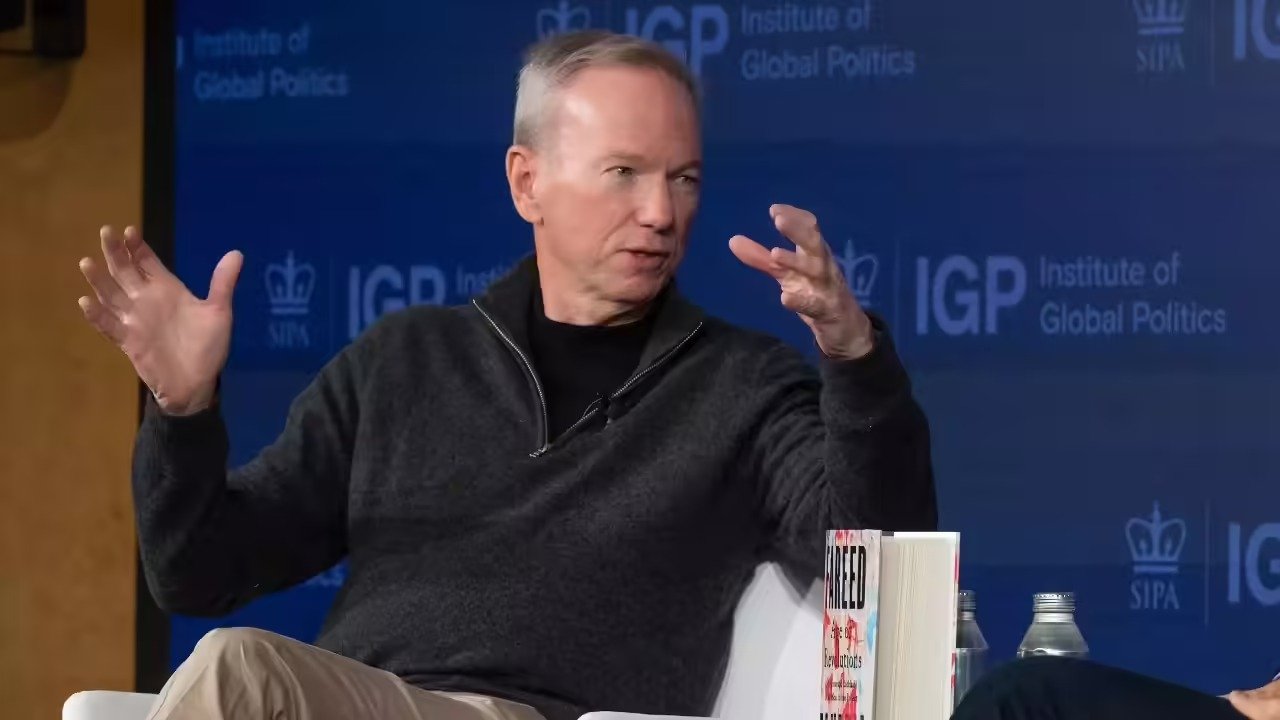
Former Google CEO Eric Schmidt has offered a candid reflection on how rapidly advancing technology particularly artificial intelligence has transformed the digital world, admitting that much of what defined his early professional life has effectively been “wiped off” or rewritten by newer innovations. His remarks have sparked widespread discussion about how fast the tech industry is evolving and how even its architects are struggling to keep pace.
Speaking about the acceleration of AI and automation, Schmidt suggested that entire skill sets, industries, and ways of working that once defined success in Silicon Valley are being replaced at unprecedented speed. What once took decades to build expertise, platforms, and even dominant business models can now be disrupted in a matter of years, or even months.
Schmidt’s career spans one of the most transformative periods in modern technology. As Google’s CEO during its rise from a search engine to a global tech powerhouse, he helped shape the internet economy, data-driven advertising, and the mobile ecosystem. Yet, he now argues that the AI revolution is more disruptive than anything that came before, including the rise of the web or smartphones.
“When I look at today’s tools,” Schmidt has said in recent discussions, “they can do in seconds what used to define a lifetime of learning.” His observation reflects a broader concern: that traditional education, career paths, and institutional knowledge are being rapidly outpaced by machines that can learn, adapt, and generate content at scale.
Rather than framing this shift purely as a loss, Schmidt emphasized the transformational potential of AI. He believes society is entering a phase where human creativity and machine intelligence will increasingly work together. However, he warned that the speed of change leaves little time for adaptation, especially for workers and institutions rooted in older systems.
One of Schmidt’s central concerns is preparedness. Governments, education systems, and businesses, he argues, are not moving fast enough to understand the consequences of AI-driven disruption. Jobs that rely heavily on pattern recognition, routine analysis, or even complex cognitive tasks are increasingly vulnerable. In this sense, what feels like personal displacement for individuals mirrors a much larger systemic reset.
At the same time, Schmidt has been vocal about the geopolitical implications of AI, particularly the race between global powers to dominate advanced technologies. He has repeatedly warned that AI leadership will define economic strength, military capability, and global influence in the decades ahead. From his perspective, failing to adapt isn’t just a personal or corporate risk it’s a national one.
His reflection about his “early life” being wiped out resonates beyond nostalgia. It underscores a reality facing millions of professionals worldwide: experience alone is no longer a guarantee of relevance. Continuous learning, flexibility, and ethical frameworks are becoming just as important as technical skill.
Despite the sobering tone, Schmidt remains optimistic. He sees AI not as an endpoint, but as a new beginning one that could unlock breakthroughs in medicine, climate science, education, and productivity. The challenge, he says, is ensuring that society evolves alongside the technology rather than being overwhelmed by it.
In acknowledging that even his own legacy tools have been overtaken, Eric Schmidt delivers a powerful message: in the age of AI, reinvention is no longer optional it is survival.