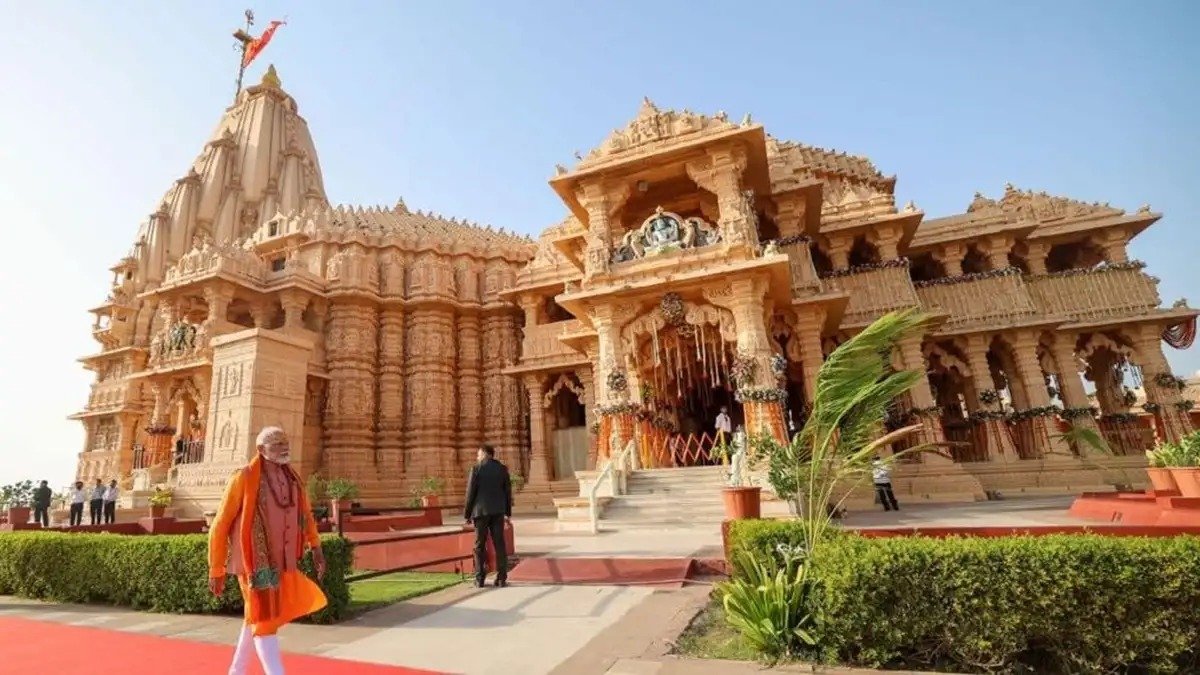
Prime Minister Narendra Modi has once again drawn national attention to the Somnath Temple in Gujarat, describing it as a powerful symbol of India’s spiritual strength and cultural resilience. Recalling its turbulent past, the Prime Minister noted how the sacred shrine was destroyed and rebuilt multiple times, yet continues to stand tall as a testament to faith that could not be erased by repeated attacks.
Located on the western coast of Gujarat, at Prabhas Patan near Veraval, Somnath is believed to be the first of the twelve Jyotirlingas of Lord Shiva, making it one of the most revered pilgrimage sites in Hinduism. Ancient scriptures, including the Skanda Purana and Shiva Purana, mention Somnath as a sacred place long before recorded history, underscoring its deep spiritual roots.
A Temple Targeted Through History
Somnath’s prominence also made it a frequent target of invasions. Historical accounts state that the temple was first destroyed in the 11th century by Mahmud of Ghazni, who looted its riches and demolished the structure. Over the centuries, Somnath faced repeated attacks and desecration by various invaders, including during the Delhi Sultanate and Mughal periods.
Yet, after every act of destruction, devotees and rulers came together to rebuild the shrine. This cycle of devastation and reconstruction turned Somnath into more than a temple it became a symbol of cultural continuity and resistance, reflecting the determination of generations who refused to let their faith be extinguished.
Rebirth After Independence
The most significant chapter in Somnath’s modern history came after India gained independence. Sardar Vallabhbhai Patel played a crucial role in initiating the reconstruction of the temple, seeing it as an assertion of national self-respect after centuries of foreign rule. The rebuilt temple was completed in the early 1950s, using traditional architectural styles and without state funding, relying largely on public contributions.
India’s first President, Dr Rajendra Prasad, inaugurated the temple in 1951, describing its reconstruction as a reflection of India’s cultural revival. Since then, Somnath has stood not only as a religious centre but also as a reminder of India’s civilisational endurance.
PM Modi’s Emphasis on Cultural Identity
By hailing Somnath Temple, PM Modi highlighted its relevance in contemporary India as a place that connects spirituality, history, and national identity. He has often referenced Somnath in speeches to underline themes of resilience, unity, and cultural pride, portraying it as a lesson from history on the importance of preserving heritage despite adversity.
Today, the Somnath Temple complex attracts millions of devotees and tourists every year. Its grand architecture, seaside location, and historical narrative make it one of the most significant spiritual landmarks in the country.
More Than Stone and Sculpture
Somnath’s story is not merely about a temple that was rebuilt; it is about a civilisation that refused to forget its roots. As PM Modi’s remarks reiterate, Somnath stands as a reminder that while structures may fall, faith, identity, and cultural memory can endure across centuries.
In celebrating Somnath’s history, the Prime Minister has once again placed the spotlight on a monument that continues to inspire India with its message of perseverance and renewal.