


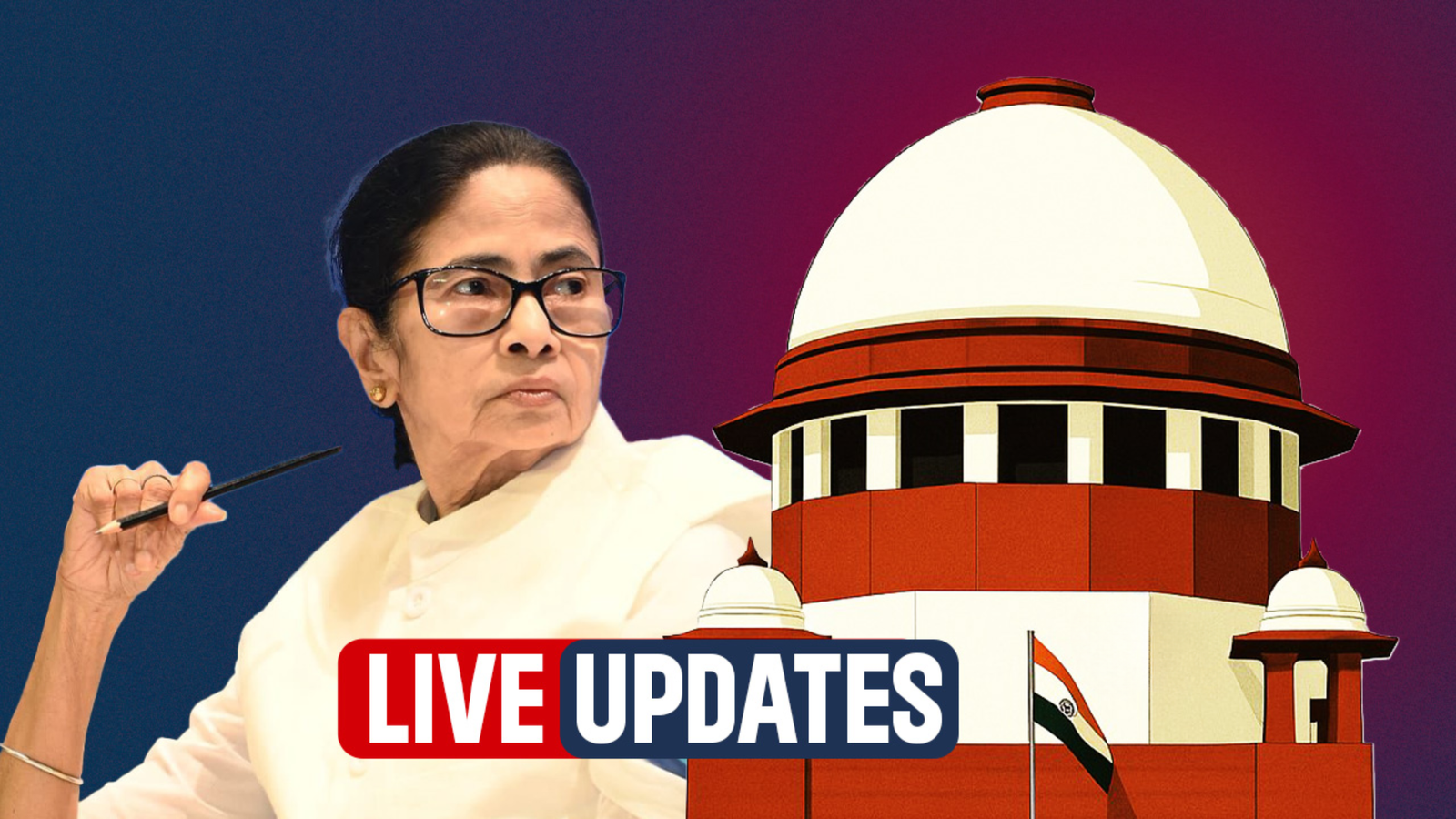
The Supreme Court on Monday began hearing a politically charged plea challenging the implementation of the Special Intensive Revision (SIR) of electoral rolls in West Bengal, with Chief Minister Mamata Banerjee personally backing the petition against what the state alleges is an overreach that could disenfranchise voters ahead of crucial elections.
The case, which has drawn national attention, centres on the Election Commission of India’s (ECI) decision to carry out a fresh and intensive verification of voter lists in select regions of West Bengal. The state government argues that the move is “arbitrary, selective, and constitutionally questionable,” while the ECI maintains that the revision is necessary to ensure the integrity of the electoral process.
Appearing before the apex court, senior advocates representing the West Bengal government contended that the timing and scope of the SIR raise serious concerns. They argued that large-scale voter verification exercises, especially close to elections, risk excluding genuine voters particularly migrant workers, minorities, and economically weaker sections who may struggle to produce documentary proof within tight deadlines.
“The right to vote is a constitutional right, not an administrative privilege,” the state’s counsel submitted, adding that the SIR could effectively amount to “mass disenfranchisement under the guise of electoral purification.”
Although Mamata Banerjee was not physically present in court, her intervention carries strong political weight. The Trinamool Congress (TMC) chief has repeatedly accused central institutions of being used to target opposition-ruled states. In recent statements, Banerjee described the SIR as a “backdoor NRC,” a reference to the controversial National Register of Citizens exercise, and warned that it could undermine democracy if allowed to proceed unchecked.
On the other side, the Election Commission defended its authority, telling the court that SIRs are a legally sanctioned mechanism under the Representation of the People Act. The Commission argued that voter list revisions are routine exercises aimed at removing duplicate, fake, or ineligible entries, and insisted that no eligible voter would be excluded without due process.
The bench, while refraining from making immediate observations, questioned the ECI on safeguards in place to prevent wrongful deletions. Judges also sought clarity on why West Bengal was selected for an intensive revision at this juncture, and whether similar exercises were being conducted uniformly across other states.
Legal experts say the case could have far-reaching implications beyond West Bengal. A ruling in favour of the state may place tighter judicial checks on the Election Commission’s discretion in conducting voter roll revisions, especially close to elections. Conversely, a verdict backing the ECI could strengthen the Commission’s hand nationwide, allowing more aggressive clean-up drives of electoral rolls.
Outside the courtroom, political reactions were swift. TMC leaders hailed the Supreme Court hearing as a “victory for democratic resistance,” while the BJP accused the state government of politicising a routine administrative process to shield illegal entries in voter lists.
The Supreme Court is expected to continue hearings over the next few days, with interim directions likely on whether the SIR can proceed while the legal challenge is pending. As the legal battle unfolds, the case has already evolved into a broader debate on electoral fairness, institutional neutrality, and the balance of power between the Centre and the states a debate that could shape the contours of India’s democracy in the months to come.


