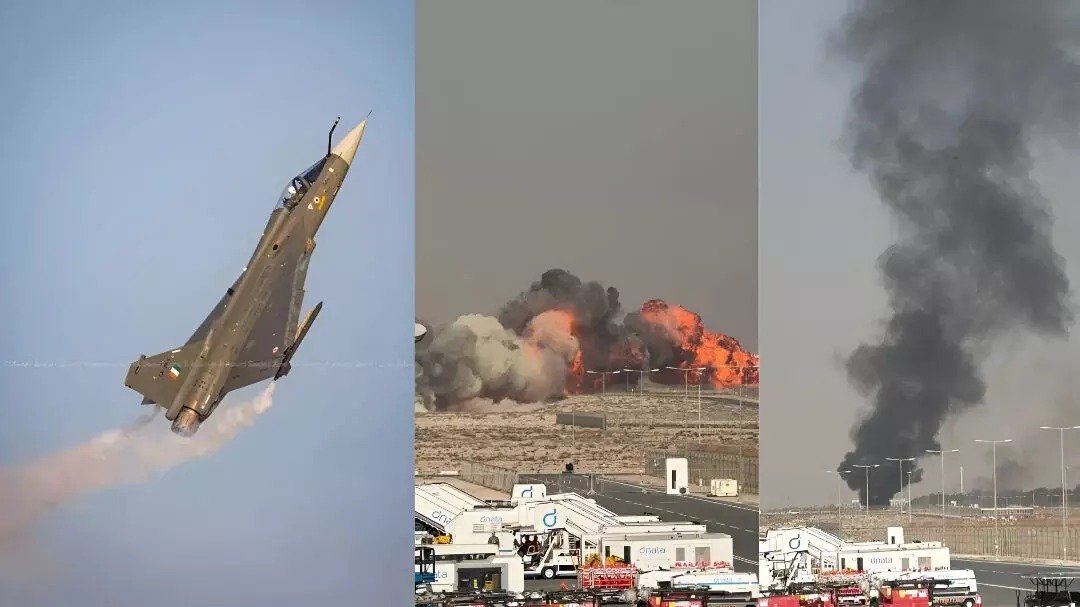
Here’s what we know so far. On November 21, 2025, during a display at the Dubai Airshow 2025 at Al Maktoum International Airport in the United Arab Emirates, a HAL Tejas light combat aircraft belonging to the Indian Air Force crashed, killing the pilot.
The Incident
During the final day of the airshow, the Tejas was performing a manoeuvre at low altitude when it apparently lost control and dived into the ground, erupting into a fireball and sending thick black smoke over the crowd. The Indian Air Force confirmed that the pilot “sustained fatal injuries” and expressed deep regret.
Who Was the Pilot
The pilot has been identified as Namansh Syal (Wing Commander), from Kangra district in Himachal Pradesh. His death has led to messages of condolence from the IAF, the government and his home state.
The Aircraft & Its Significance
The Tejas is India’s indigenous lightweight multi-role fighter aircraft, developed jointly by Hindustan Aeronautics Limited (HAL) and the Aeronautical Development Agency. It’s a key part of India’s effort to modernise the Air Force fleet. The crash marks only the second known accident involving the Tejas and the first fatal one.
Immediate Aftermath & Investigation
The airshow’s flying displays were temporarily suspended, emergency crews responded quickly and the crash site was secured. The IAF has initiated a court of inquiry to determine what exactly went wrong.
Context & What It Means
- The crash happened during a high-visibility international event with many spectators. The visuals of the aircraft going down and bursting into flames have already circulated widely.
- For India, the Tejas programme carries national pride as well as strategic importance. Such an accident raises questions about operational safety, maintenance, pilot training under high-stress conditions, and aircraft performance under display conditions.
- While investigations are ongoing, it’s too early to draw conclusions about cause, whether mechanical failure, pilot error, environmental factors, or a combination.
- For the pilot’s family, the IAF and nation have expressed solidarity. But beyond the official lines, the human cost is stark: a life lost during a display meant to demonstrate aerial capability.
What to Watch For
- The findings of the court of inquiry into the crash: what exactly triggered the loss of control at low altitude?
- Any potential grounding or review of the Tejas fleet’s display operations or training protocols.
- Impact on India’s defence-industrial programme, how this affects perception of the Tejas, both domestically and internationally.
- Responses from HAL: whether any manufacturing or maintenance factors emerge as issues.
- Safety measures at airshows: this incident is likely to prompt stricter rules regarding low-altitude manoeuvres, crowd protection, and aircraft-display protocols.
Final Thoughts
This is a heavy moment: an aircraft representing India’s home-grown capability crashes during a live display, and a pilot pays the ultimate price. While the technical and strategic implications will be dissected over time, what remains immediate is respect for the pilot and the gravity of what happened. The investigation will matter, not just for the Tejas programme or the Indian Air Force, but for how aerial demonstrations are conducted and how risks are managed.