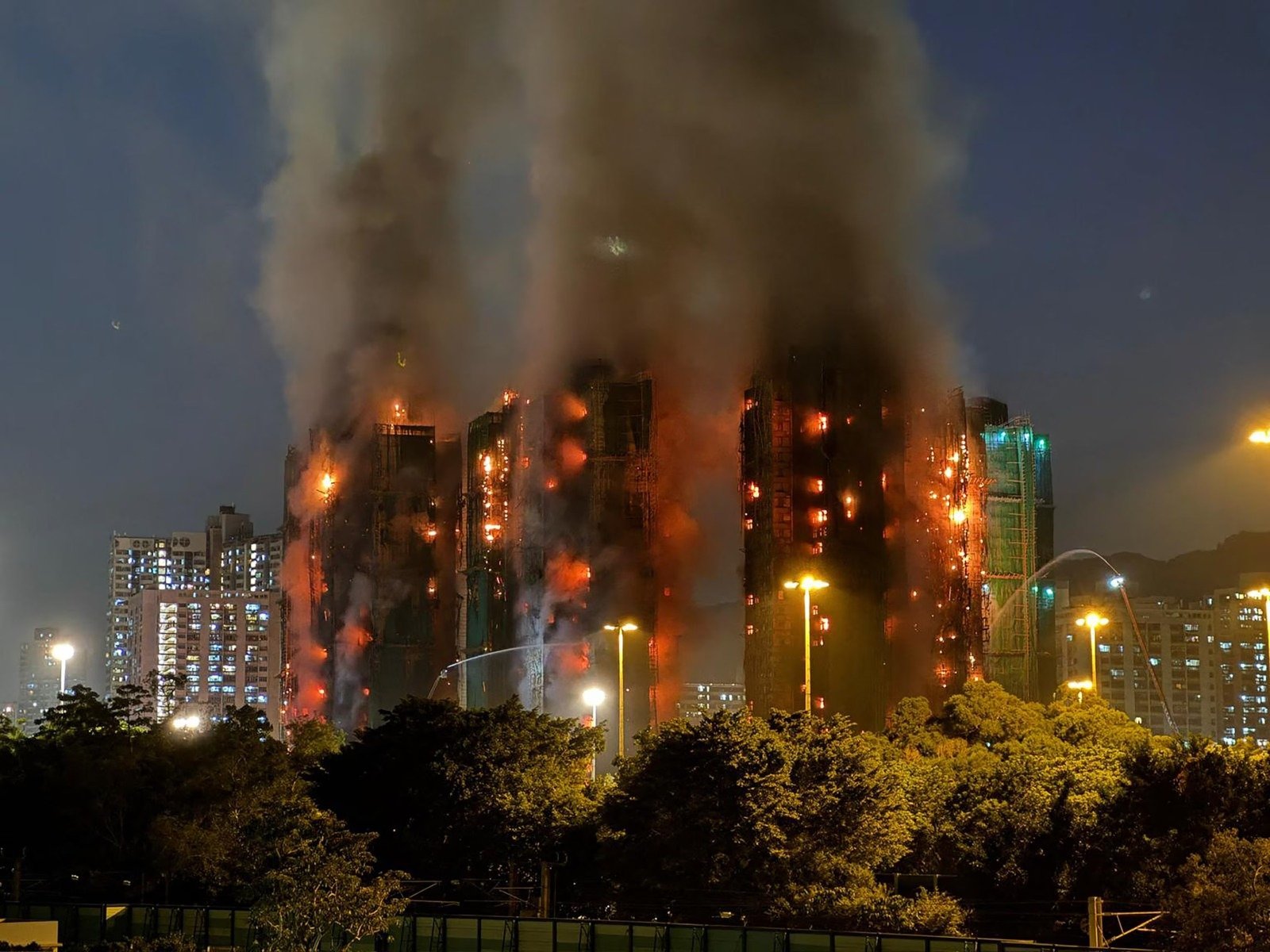
The images coming out of Hong Kong this week are hard to forget. Flames stretching several floors high, smoke pouring into the sky, and people running for safety in the middle of absolute chaos. A massive fire broke out across multiple high-rise towers, and as of now, 44 people have been confirmed dead, with hundreds still unaccounted for.
Let’s break down what happened, why this incident turned so deadly, and what investigators are looking at right now.
What Happened
The fire reportedly started in one of the high-rise residential blocks late in the evening, then spread shockingly fast across adjoining towers. Videos taken by residents show entire walls of the buildings lit up, with fire climbing vertically within minutes. Firefighters battled the blaze through the night, but the scale of the disaster became clear only the next morning.
Survivors describe hearing explosions, panicked footsteps in the hallways, and thick smoke that made escape almost impossible.
Casualties and Missing Persons
Authorities have confirmed 44 deaths so far. This number may rise as search teams continue to sweep through damaged floors. Hundreds of residents are still missing, and communication with many families remains incomplete because of blocked stairwells, collapsed sections, and unstable structures.
Hospitals across Hong Kong are treating dozens with severe burns, smoke inhalation, and trauma-related injuries.
How the Fire Spread So Quickly
High-rise fires are always risky, but this one escalated unusually fast. Early reports suggest a mix of factors:
- Older building materials in certain towers
- Closed-off ventilation areas that may have trapped heat
- Cluttered escape routes in some units
- Strong winds that pushed the fire upwards
Officials are still investigating, but they’re already calling this one of the deadliest urban fires in recent Hong Kong history.
Rescue Operations
Firefighters conducted door-to-door searches, trying to break into locked units and pull people from smoke-filled hallways. Drones were deployed to scan window areas where people were last seen signaling for help. More than 1,500 residents were evacuated, many still in shock and without their belongings.
Volunteers and local organizations have stepped up with food, water, temporary lodging, and emotional support.
Government Response
The Hong Kong government has launched a formal inquiry into the cause of the fire, safety lapses, and evacuation failures. Officials are also reviewing building safety codes, especially for older residential complexes that house thousands.
At the same time, support funds are being arranged for victims’ families and those who have lost their homes.
Why This Incident Hits Hard
Hong Kong is known for its dense vertical living. Millions stay in tightly packed high-rises. A disaster like this exposes how vulnerable residents can be when a single emergency spirals out of control.
It also raises bigger questions:
- Are old tower blocks equipped to handle today’s fire risks?
- Were escape routes kept clear and accessible?
- How quickly were residents alerted?
- Are safety inspections consistent and transparent?
For many, this disaster is a wake-up call.
What Happens Next
Investigations will continue for weeks. Rescue teams will keep searching for survivors. Families will keep waiting for news about their missing loved ones. And the city will have to confront difficult conversations about living safety in high-rise environments.
For now, Hong Kong is grieving. The loss is heavy, the questions are many, and the recovery will take time.Let’s break down what happened, why this incident turned so deadly, and what investigators are looking at right now.
What Happened
The fire reportedly started in one of the high-rise residential blocks late in the evening, then spread shockingly fast across adjoining towers. Videos taken by residents show entire walls of the buildings lit up, with fire climbing vertically within minutes. Firefighters battled the blaze through the night, but the scale of the disaster became clear only the next morning.
Survivors describe hearing explosions, panicked footsteps in the hallways, and thick smoke that made escape almost impossible.
Casualties and Missing Persons
Authorities have confirmed 44 deaths so far. This number may rise as search teams continue to sweep through damaged floors. Hundreds of residents are still missing, and communication with many families remains incomplete because of blocked stairwells, collapsed sections, and unstable structures.
Hospitals across Hong Kong are treating dozens with severe burns, smoke inhalation, and trauma-related injuries.
How the Fire Spread So Quickly
High-rise fires are always risky, but this one escalated unusually fast. Early reports suggest a mix of factors:
- Older building materials in certain towers
- Closed-off ventilation areas that may have trapped heat
- Cluttered escape routes in some units
- Strong winds that pushed the fire upwards
Officials are still investigating, but they’re already calling this one of the deadliest urban fires in recent Hong Kong history.
Rescue Operations
Firefighters conducted door-to-door searches, trying to break into locked units and pull people from smoke-filled hallways. Drones were deployed to scan window areas where people were last seen signaling for help. More than 1,500 residents were evacuated, many still in shock and without their belongings.
Volunteers and local organizations have stepped up with food, water, temporary lodging, and emotional support.
Government Response
The Hong Kong government has launched a formal inquiry into the cause of the fire, safety lapses, and evacuation failures. Officials are also reviewing building safety codes, especially for older residential complexes that house thousands.
At the same time, support funds are being arranged for victims’ families and those who have lost their homes.
Why This Incident Hits Hard
Hong Kong is known for its dense vertical living. Millions stay in tightly packed high-rises. A disaster like this exposes how vulnerable residents can be when a single emergency spirals out of control.
It also raises bigger questions:
- Are old tower blocks equipped to handle today’s fire risks?
- Were escape routes kept clear and accessible?
- How quickly were residents alerted?
- Are safety inspections consistent and transparent?
For many, this disaster is a wake-up call.
What Happens Next
Investigations will continue for weeks. Rescue teams will keep searching for survivors. Families will keep waiting for news about their missing loved ones. And the city will have to confront difficult conversations about living safety in high-rise environments.
For now, Hong Kong is grieving. The loss is heavy, the questions are many, and the recovery will take time.
The images coming out of Hong Kong this week are hard to forget. Flames stretching several floors high, smoke pouring into the sky, and people running for safety in the middle of absolute chaos. A massive fire broke out across multiple high-rise towers, and as of now, 44 people have been confirmed dead, with hundreds still unaccounted for.
Let’s break down what happened, why this incident turned so deadly, and what investigators are looking at right now.
What Happened
The fire reportedly started in one of the high-rise residential blocks late in the evening, then spread shockingly fast across adjoining towers. Videos taken by residents show entire walls of the buildings lit up, with fire climbing vertically within minutes. Firefighters battled the blaze through the night, but the scale of the disaster became clear only the next morning.
Survivors describe hearing explosions, panicked footsteps in the hallways, and thick smoke that made escape almost impossible.
Casualties and Missing Persons
Authorities have confirmed 44 deaths so far. This number may rise as search teams continue to sweep through damaged floors. Hundreds of residents are still missing, and communication with many families remains incomplete because of blocked stairwells, collapsed sections, and unstable structures.
Hospitals across Hong Kong are treating dozens with severe burns, smoke inhalation, and trauma-related injuries.
How the Fire Spread So Quickly
High-rise fires are always risky, but this one escalated unusually fast. Early reports suggest a mix of factors:
- Older building materials in certain towers
- Closed-off ventilation areas that may have trapped heat
- Cluttered escape routes in some units
- Strong winds that pushed the fire upwards
Officials are still investigating, but they’re already calling this one of the deadliest urban fires in recent Hong Kong history.
Rescue Operations
Firefighters conducted door-to-door searches, trying to break into locked units and pull people from smoke-filled hallways. Drones were deployed to scan window areas where people were last seen signaling for help. More than 1,500 residents were evacuated, many still in shock and without their belongings.
Volunteers and local organizations have stepped up with food, water, temporary lodging, and emotional support.
Government Response
The Hong Kong government has launched a formal inquiry into the cause of the fire, safety lapses, and evacuation failures. Officials are also reviewing building safety codes, especially for older residential complexes that house thousands.
At the same time, support funds are being arranged for victims’ families and those who have lost their homes.
Why This Incident Hits Hard
Hong Kong is known for its dense vertical living. Millions stay in tightly packed high-rises. A disaster like this exposes how vulnerable residents can be when a single emergency spirals out of control.
It also raises bigger questions:
- Are old tower blocks equipped to handle today’s fire risks?
- Were escape routes kept clear and accessible?
- How quickly were residents alerted?
- Are safety inspections consistent and transparent?
For many, this disaster is a wake-up call.
What Happens Next
Investigations will continue for weeks. Rescue teams will keep searching for survivors. Families will keep waiting for news about their missing loved ones. And the city will have to confront difficult conversations about living safety in high-rise environments.
For now, Hong Kong is grieving. The loss is heavy, the questions are many, and the recovery will take time.The images coming out of Hong Kong this week are hard to forget. Flames stretching several floors high, smoke pouring into the sky, and people running for safety in the middle of absolute chaos. A massive fire broke out across multiple high-rise towers, and as of now, 44 people have been confirmed dead, with hundreds still unaccounted for.
Let’s break down what happened, why this incident turned so deadly, and what investigators are looking at right now.
What Happened
The fire reportedly started in one of the high-rise residential blocks late in the evening, then spread shockingly fast across adjoining towers. Videos taken by residents show entire walls of the buildings lit up, with fire climbing vertically within minutes. Firefighters battled the blaze through the night, but the scale of the disaster became clear only the next morning.
Survivors describe hearing explosions, panicked footsteps in the hallways, and thick smoke that made escape almost impossible.
Casualties and Missing Persons
Authorities have confirmed 44 deaths so far. This number may rise as search teams continue to sweep through damaged floors. Hundreds of residents are still missing, and communication with many families remains incomplete because of blocked stairwells, collapsed sections, and unstable structures.
Hospitals across Hong Kong are treating dozens with severe burns, smoke inhalation, and trauma-related injuries.
How the Fire Spread So Quickly
High-rise fires are always risky, but this one escalated unusually fast. Early reports suggest a mix of factors:
- Older building materials in certain towers
- Closed-off ventilation areas that may have trapped heat
- Cluttered escape routes in some units
- Strong winds that pushed the fire upwards
Officials are still investigating, but they’re already calling this one of the deadliest urban fires in recent Hong Kong history.
Rescue Operations
Firefighters conducted door-to-door searches, trying to break into locked units and pull people from smoke-filled hallways. Drones were deployed to scan window areas where people were last seen signaling for help. More than 1,500 residents were evacuated, many still in shock and without their belongings.
Volunteers and local organizations have stepped up with food, water, temporary lodging, and emotional support.
Government Response
The Hong Kong government has launched a formal inquiry into the cause of the fire, safety lapses, and evacuation failures. Officials are also reviewing building safety codes, especially for older residential complexes that house thousands.
At the same time, support funds are being arranged for victims’ families and those who have lost their homes.
Why This Incident Hits Hard
Hong Kong is known for its dense vertical living. Millions stay in tightly packed high-rises. A disaster like this exposes how vulnerable residents can be when a single emergency spirals out of control.
It also raises bigger questions:
- Are old tower blocks equipped to handle today’s fire risks?
- Were escape routes kept clear and accessible?
- How quickly were residents alerted?
- Are safety inspections consistent and transparent?
For many, this disaster is a wake-up call.
What Happens Next
Investigations will continue for weeks. Rescue teams will keep searching for survivors. Families will keep waiting for news about their missing loved ones. And the city will have to confront difficult conversations about living safety in high-rise environments.
For now, Hong Kong is grieving. The loss is heavy, the questions are many, and the recovery will take time.