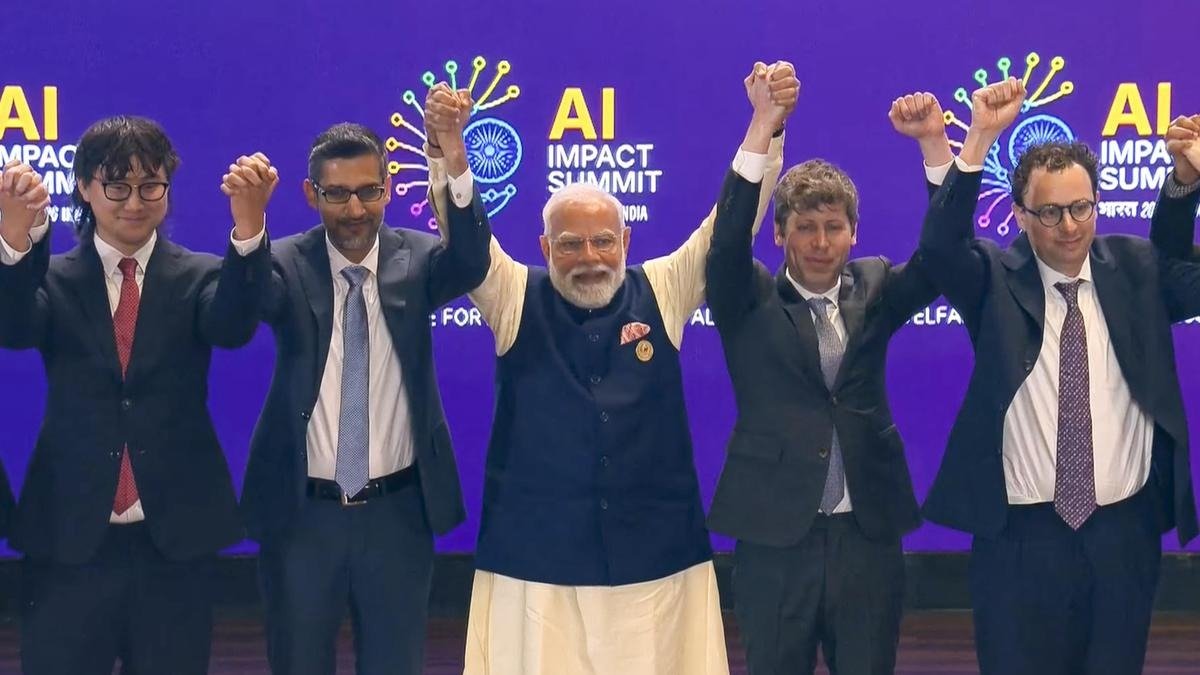
On the fourth and final day of the India AI Summit 2026 in New Delhi, Prime Minister Narendra Modi unveiled the government’s flagship AI governance framework the ‘MANAV Vision’, aimed at shaping a future where artificial intelligence works ethically, inclusively, and for the benefit of all citizens.
Here are the key live highlights and developments from Day 4:
🌐 PM Modi Unveils ‘MANAV Vision’
The Prime Minister described the MANAV Vision as India’s comprehensive approach to AI governance, centred on four pillars:
M – Moral & ethical AI
Promoting fairness, transparency, and human-centric values in AI systems.
A – Accountability & Safety
Ensuring AI deployments are auditable, secure, and aligned with legal norms.
N – National Inclusivity
Bringing AI benefits to all sections of society urban and rural, rich and poor.
A – Accessible Innovation
Supporting open research, localisation, and tools for startups and developers.
V – Value-Driven Growth
Harnessing AI for national priorities such as healthcare, agriculture, education, and climate resilience.
PM Modi underscored that India’s approach would balance innovation with safeguards, avoiding extremes of unrestricted experimentation or over-regulation.
🧠 Global AI Declaration Discussion
The summit also advanced conversations around a proposed “Delhi Declaration on Responsible AI,” which aims to establish shared principles among participating nations, including:
- Ethical standards
- Cross-border data cooperation
- AI for public good
- Safety frameworks
Participating delegations expressed preliminary support for initiating draft text and working groups.
🤝 International Participation and Cooperation
Leaders and officials from countries across Asia, Europe, Africa, and the Americas were present, reflecting broad interest in AI governance norms.
Highlights included:
- Multilateral panels on AI and human rights
- Workshops on trustworthy AI standards
- Breakout sessions on AI in public services and equitable digital inclusion
📊 Industry and Research Engagement
Top AI researchers, global tech CEOs, and academic leaders showcased innovations aligned with ethical and inclusive principles, including:
- AI tools for accessible education
- AI-assisted healthcare diagnostics
- Inclusive language models for regional languages
- AI for climate and crop forecasting
💡 Emphasis on India’s AI Roadmap
PM Modi also outlined future steps under the MANAV Vision, including:
✔️ Launch of a National AI Ethics Council
✔️ Expansion of AI research hubs in Tier-II and Tier-III cities
✔️ Grants for ethical AI startups
✔️ Public-sector AI accelerators for governance and citizen services
He reiterated that technology must be “guided by human values and not by unbridled commercial pressures.”
🗣️ Reactions from Delegates
Global leaders and experts lauded India’s initiative as forward-looking and values-based, with several emphasising:
- India’s voice adds diversity to global AI governance
- Ethical frameworks are essential as AI scales
- Collaboration is key to equitable technology futures
Industry representatives welcomed the vision’s emphasis on inclusive growth and practical applications across social sectors.
🔚 Closing Moments of the Summit
As Day 4 progressed:
- Participants engaged in Q&A sessions with ministers
- Working groups drafted next-stage AI cooperation proposals
- Summit organisers outlined follow-up timelines for international deliberations
The event concluded with a consensus that responsible AI frameworks must evolve through global cooperation, national values, and multidisciplinary input.
🔎 Bottom Line
The MANAV Vision marks India’s ambitious entry into global AI governance discourse one that balances ethical safeguards with innovation, prioritises inclusive access, and seeks to make India a hub for responsible AI development.
The Summit ends not just with speeches, but with concrete policy directions and international momentum toward shared AI norms.
If you’d like, I can also provide a live feed of quotes and reactions from global leaders at the Summit!