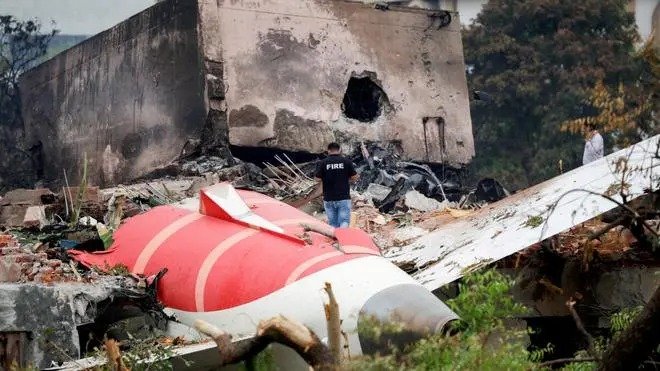
An Italian media report has sparked controversy after claiming that an investigation into a recent Air India crash concluded the incident was intentional, alleging that the pilot deliberately cut the aircraft’s fuel supply mid-flight. The claims, which cite unnamed investigative sources, have yet to be officially confirmed by Indian aviation authorities.
According to the report, preliminary findings from the probe suggested that the aircraft’s fuel control switches were manually turned off, leading to a catastrophic loss of engine power. The publication alleged that cockpit voice recordings and flight data analysis indicated deliberate action rather than mechanical failure.
However, Indian authorities have not endorsed these conclusions. Officials from the Directorate General of Civil Aviation (DGCA) and the Aircraft Accident Investigation Bureau (AAIB) have refrained from commenting on speculative reports, stating that the investigation remains ongoing and that only a final report will determine the cause of the crash.
Official Silence, Ongoing Investigation
Aviation experts caution that accident investigations are complex and typically require months of data analysis, simulation, and cross-verification before any definitive conclusions can be drawn. Early leaks or media reports, they warn, can sometimes misrepresent incomplete findings.
“No conclusion should be considered final until the official report is released,” a senior aviation analyst said. “Fuel switch movement alone does not automatically prove intent. Investigators must rule out system malfunction, cockpit confusion, or other technical scenarios.”
Air India has also declined to comment on what it described as “speculative reporting,” reiterating that it is fully cooperating with investigative agencies.
What Investigators Typically Examine
In aircraft crash probes involving suspected manual input, investigators examine:
- Cockpit voice recorder (CVR) data
- Flight data recorder (FDR) readings
- Crew training and mental health records
- Aircraft maintenance history
- Possible system failures or warnings
- Air traffic control communications
Any claim of intentional action would require substantial corroborative evidence, including behavioural patterns and procedural deviations.
Industry and Public Reaction
The Italian report has triggered widespread discussion in aviation circles and on social media. Some observers have urged caution, pointing out that unverified claims can unfairly damage reputations before formal findings are established.
Others argue that transparency is essential and that if evidence supports such a conclusion, it must be addressed with clarity and accountability.
Awaiting Official Confirmation
As of now, there has been no official confirmation that the crash was intentional or that the pilot deliberately cut the fuel switch. Aviation authorities are expected to release interim findings if necessary, followed by a comprehensive final report.
Until then, experts stress that conclusions based solely on external media reports should be treated carefully.
The investigation continues, and clarity is likely to emerge only once authorities complete a full technical and procedural review.