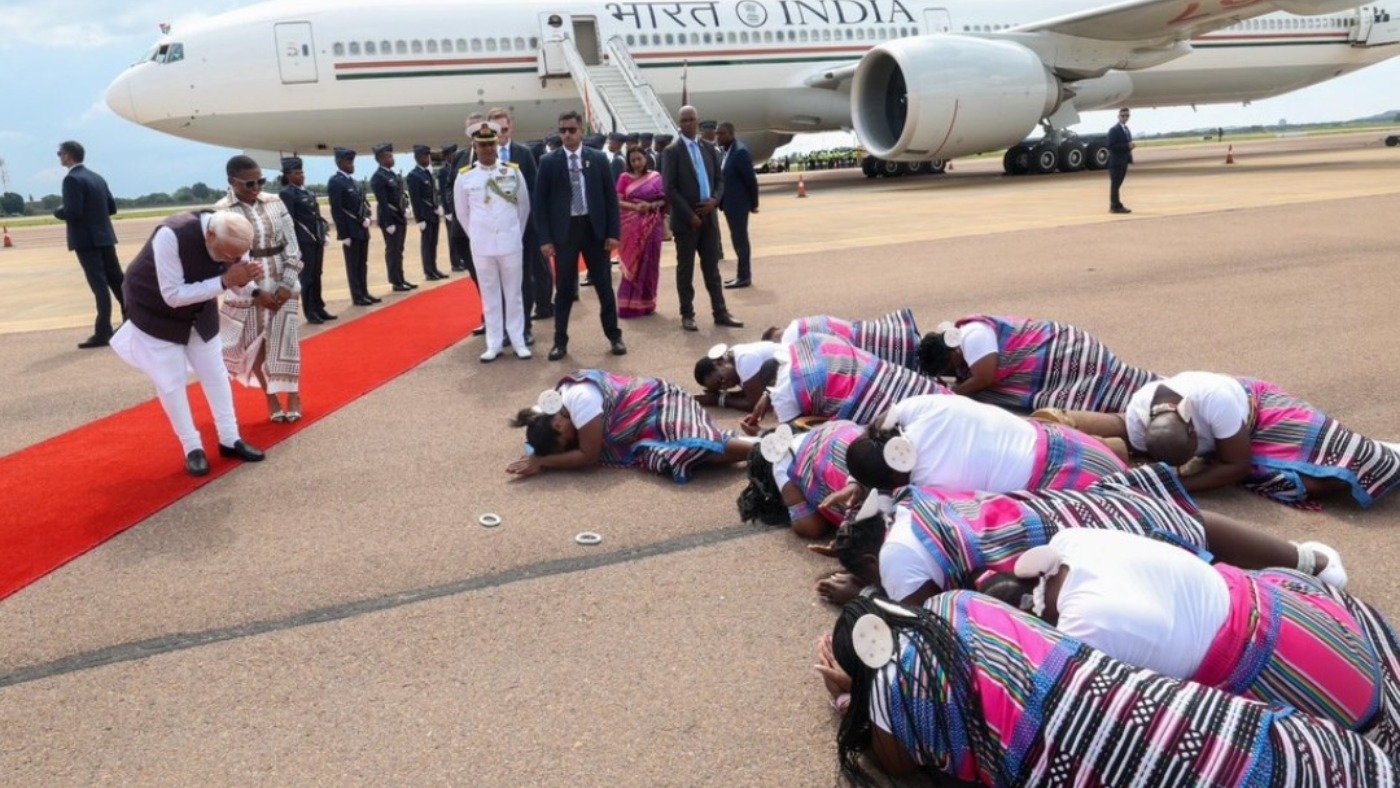
Narendra Modi landed in Johannesburg for the 2025 G20 Johannesburg Summit, the first time the summit is held on African soil.
He received a ceremonial welcome, cultural performances, a greeting by the host government, and a warm reception from India’s diaspora in South Africa.
In a message ahead of the summit, Modi framed India’s participation in terms of “One Earth, One Family, One Future” and the ancient Indian idea of Vasudhaiva Kutumbakam.
What this really means is that India is looking to push a global agenda that isn’t just about its own interests, but about the Global South, development, and inclusive growth.
The summit’s official theme is “Solidarity, Equality and Sustainability.”
Here are the key focus areas – many of which align with India’s priorities:
- Inclusive & Sustainable Economic Growth
- Topics: trade, financing for development, managing debt burdens.
- India will push for development that leaves no one behind, especially in the Global South.
- A Resilient World
- Topics: disaster risk reduction, climate change, just energy transitions, food systems.
- India’s angle: emphasising resilience and sustainability while recognising its development path.
- A Fair and Just Future
- Topics: critical minerals, decent work, artificial intelligence.
- This signals a shift: not only growth, but also the quality of growth. Tech, fairness, labour rights.
- Global South & Africa-Centric Priorities
- Being the first African-hosted G20, this summit offers a chance for African voices to be central.
- India aims to amplify these voices: development, infrastructure, capacity building.
- Bilateral & Multilateral Engagements
- Modi has scheduled meetings on the sidelines: with Australia’s PM Anthony Albanese, among others.
Why It Matters for India
- India wants to shape the narrative around global governance. Modi’s remark of presenting India’s perspective signals this.
- The Indian diaspora in South Africa is among the largest outside India; engaging them builds soft power and people-to-people links.
- India can leverage its G20 participation to push for issues which benefit middle- and low-income countries: debt relief, climate finance, infrastructure support.
- Holding this summit in Africa gives a symbolic boost: the “Global South” is not just attending, it’s hosting and setting agenda.
Key Moves to Watch
- Modi’s remarks in the three summit sessions (economics, resilience, future) – will they introduce new Indian proposals or initiatives?
- Bilateral meetings, these often lead to trade/investment deals, defence & technology pacts.
- Outcomes of the summit: any major declarations, commitments to financing, climate action, technology transfer.
- How India positions itself vis-à-vis the Global South vs. developed economies.
- Media and public reactions: does the summit deliver for Africa and the Global South, or is it seen as symbolic only?
Conclusion
Modi’s arrival in Johannesburg marks more than just attendance at the G20. It’s about positioning India as a bridge between developing and developed worlds, aligning with Africa’s rising role, and pushing for an agenda that balances growth with fairness, technology with inclusion, and national interest with global responsibility.
What comes out of the next days, statements, partnerships, commitments, will tell how effective this positioning actually is.